It's 2 PM on your busiest Saturday. A family of four shows up for their 2 PM dolphin tour, only to find another group already boarding for the same trip. You overbooked. Now you're scrambling to explain, offering refunds, watching one family's vacation memories evaporate into frustration and disappointment.
That single double-booking doesn't just ruin one customer's experience. Research shows it can cost you 22% of potential future customers (Moz research via ReputationX) when the inevitable negative review hits TripAdvisor or Google.
Here's the thing: in 2024, double bookings shouldn't happen. Real-time availability sync technology has existed for years. Yet businesses still lose millions to scheduling conflicts because they're trying to manage bookings across phone calls, walk-ins, online reservations and OTA platforms, often with nothing more than a paper calendar or disconnected spreadsheet.
The True Cost of Double Booking
Double booking isn't just an inconvenience, it's a business crisis. According to industry data the consequences cascade far beyond the immediate incident:
The Domino Effect of One Double-Booking
According to Booking.com, double bookings are common in 25% of first-year short-term rentals. ThinkJar research shows 55% of consumers will abandon a brand after just one bad experience and 86% after two. Dissatisfied customers typically tell 9 to 15 other people about their experience, some tell 20 or more.
The financial math is stark: for a hotel with a $125 average daily rate, just one negative review can cost $18,625 in lost bookings. Four negative reviews in a month? That's $59,533 in monthly revenue leakage.
Revenue Impact: One Double-Booking vs. Zero Conflicts
Cumulative 12-month revenue comparison for a tour operator ($350 avg booking)
Why Double Bookings Still Happen in 2024
With all the technology available, why do scheduling conflicts persist? The root causes are surprisingly common:
Human Error
Manual data entry has a 4% error rate. For 100 bookings, that's 4 mistakes waiting to happen and 100x more errors than automated systems.
Multiple Booking Channels
Phone, walk-ins, website, Viator, GetYourGuide, Airbnb, each channel is a potential source of conflict if not synchronized in real time.
Sync Delays
iCal sync can have 15-minute delays. Phone bookings may not update until staff "gets around to it." That's enough time for three double-bookings.
Staff Coordination Gaps
When two employees take bookings without checking with each other, conflicts multiply. Poor handoff protocols create scheduling chaos.
The fundamental problem? Most businesses are still trying to manage 2024 booking volumes with 1994 technology.
⚠️ The Phone Booking Gap
While 72% of travelers prefer online booking, phone calls still drive 30-40% of bookings for experience-based businesses. These phone bookings are where sync breaks down, someone takes a call, scribbles on a notepad and promises to update the calendar "in a minute." That minute becomes an hour. Meanwhile the same slot sells online.
The Scenario: What Double Booking Actually Looks Like
❌ Without Real-Time Sync
- 9:15 AM: Jane calls to book the 2 PM sunset sail for 4 people. You write it down.
- 9:18 AM: Before you update the online calendar, Tom books the same 2 PM slot on Viator.
- 9:45 AM: You finally update your system. No red flags, Viator hasn't synced yet.
- 1:55 PM: Both families arrive. Maximum capacity: 6. You have 8 people.
- 2:00 PM: Awkward conversation. Someone gets turned away.
- 9:00 PM: 1-star review posted with photos of disappointed kids.
✓ With AI Phone Agent + Real-Time Sync
- 9:15 AM: Jane calls. AI agent checks live availability, 2 PM has 6 spots.
- 9:16 AM: AI books Jane's party of 4. Calendar updates instantly.
- 9:18 AM: Tom tries to book on Viator. System shows only 2 spots left.
- 9:18 AM: Tom books for 2 people, perfect fit.
- 1:55 PM: Both families arrive. Exactly 6 guests. Smooth sailing.
- 9:00 PM: 5-star review: "Perfectly organized from booking to boarding!"
How AI Phone Agents Eliminate Double Bookings
The key to eliminating double bookings isn't just better software, it's eliminating the human delay between "yes, you're booked" and "calendar updated." Here's how AI phone agents solve this:
❌ Traditional Phone Booking
- Time to update calendar5-60 min
- Human error rate4%
- Multi-channel syncManual
- Conflict detectionNone
- 24/7 accuracyNo
- OTA sync delay15+ min
✓ AI Phone Agent
- Time to update calendarInstant
- Human error rate0%
- Multi-channel syncAutomatic
- Conflict detectionReal-time
- 24/7 accuracyYes
- OTA sync delay< 1 min
Instant Calendar Lock
The moment a caller says "yes," the slot is locked across all platforms simultaneously.
Two-Way API Sync
Real-time connections to booking platforms mean changes propagate in seconds, not minutes.
Conflict Prevention
AI checks availability before offering time slots, impossible to book what's already taken.
💡 Key Insight
Traditional channel managers sync calendars every 15 minutes, fast for software, but an eternity during peak booking periods. AI phone agents integrate directly with your booking system via real-time API, updating availability the moment the customer confirms. No gaps. No delays. No double bookings.
Integration Ecosystem: Platforms That Sync Instantly
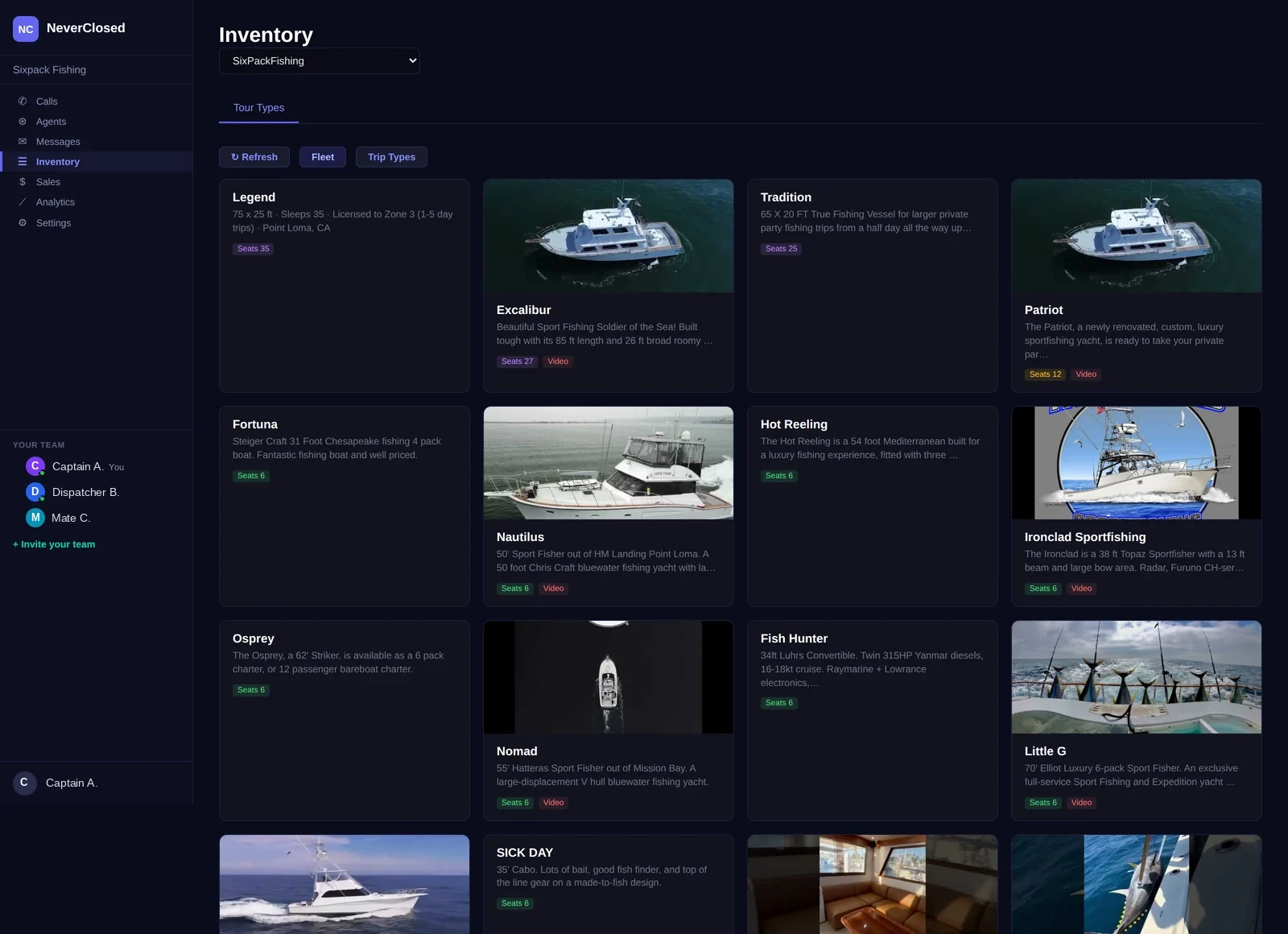
NeverClosed.AI connects to your existing booking infrastructure through certified real-time integrations:
Whether you use a property management system, tour operator software or simple Google Calendar the AI agent pulls live availability and writes back confirmed bookings instantly.
Booking Error Rates: Human vs. AI
Percentage of scheduling conflicts per 1,000 bookings
The ROI of Zero Double Bookings
Let's calculate the actual financial impact for a typical tour operator handling 200 bookings per month:
Monthly Cost-Benefit Analysis: Eliminating Double Bookings
| Factor | Without AI | With AI |
|---|---|---|
| Monthly bookings | 200 | 200 |
| Double-booking rate | 4% | 0% |
| Double bookings per month | 8 | 0 |
| Average refund/compensation per incident | $250 | , |
| Monthly refund costs | -$2,000 | $0 |
| Negative reviews generated | 3 | 0 |
| Lost customers from reviews (22% × 200) | 44 customers | 0 |
| Lost revenue from review damage ($350 avg) | -$15,400 | $0 |
| AI phone agent cost | , | -$250* |
| Net Monthly Savings | +$17,150 |
*$250/month or 2.5% of AI-generated sales, whichever is greater. At $70,000 monthly revenue, this would be $250 (the minimum). At $15,000 monthly revenue it would still be $250. Only businesses generating over $10,000/month in AI-booked sales pay more than $250.
Beyond Double Bookings : The Complete Sync Advantage
Real-time calendar sync doesn't just prevent double bookings. It unlocks additional benefits:
- Capture last-minute bookings: When a slot opens from a cancellation the AI can immediately offer it to the next caller
- Optimize capacity: AI can suggest alternative times when preferred slots are full, maximizing daily revenue
- Resource management: Track guides, equipment and vehicles alongside bookings to prevent resource conflicts
- Dynamic availability: Automatically adjust available slots based on staff schedules, weather or special events
Customer Experience: Review Scores Before vs. After Real-Time Sync
Average star ratings for businesses with manual vs. automated booking sync
Implementation: Getting to Zero Double Bookings
Transitioning to a zero-conflict booking system is straightforward:
Connect Your Calendar
Link your existing booking system (Google Calendar, FareHarbor, Checkfront, etc.) via API or OAuth. Takes under 10 minutes for most platforms.
Define Your Inventory
Set capacity limits for each time slot, resource constraints (boats, guides, equipment) and buffer times between trips.
Train the AI on Your Services
Upload your tour descriptions, pricing and booking rules. The AI learns what to offer and when.
Go Live with Confidence
Every phone booking now syncs instantly. Monitor the dashboard to see real-time availability across all channels.
✓ Best Practice: The "Last Room" Buffer
Many businesses using channel managers include a "safety buffer", keeping the last room or slot unavailable until synchronization is confirmed. With real-time AI phone agents, this buffer becomes unnecessary, unlocking that extra capacity for real revenue.
Industries That Benefit Most
Real-time sync is critical for any business where:
- Capacity is fixed: Tours, boats, vehicles, rooms, you can't create more inventory on the fly
- Experiences are time-sensitive: Sunset sails, tee times, cooking classes, customers expect specific slots
- Multiple booking channels exist: Phone, website, OTAs, walk-ins all competing for the same inventory
- Reviews matter: Tourism, hospitality and services where one bad experience spreads quickly
Whether you're running a fishing charter, helicopter tour, escape room or dental practice the principle is the same: real-time sync prevents the scheduling conflicts that destroy customer trust.
The Bottom Line
Double bookings are preventable. Every single one.
The technology exists. The integrations are ready. The only remaining barrier is the gap between when someone says "yes, book it" on the phone and when that booking appears in your system.
AI phone agents close that gap permanently. They check live availability before offering time slots. They confirm bookings instantly. They sync across every channel simultaneously.
No more frantic calls to customers explaining the mix-up. No more refunds and compensation. No more 1-star reviews mentioning "disorganized" or "overbooked."
Just smooth operations, happy customers and a calendar you can trust.
Ready to Eliminate Double Bookings Forever?
See how AI phone agents with real-time calendar sync can protect your business from scheduling conflicts.
Get a DemoSources & Research
- [1] Booking.com Partner Help. Double bookings common in 25% of first-year short-term rentals.
- [2] DocuClipper/Human Error Statistics. Manual data entry has 4% error rate; automated systems 100x more accurate.
- [3] Viqal Hotel Research. One negative review can deter 22% of new customers; 4 reviews = 70% revenue loss.
- [4] ThinkJar Research. 55% of consumers abandon brands after one bad experience; 86% after two.
- [5] White House Office of Consumer Affairs. Dissatisfied customers tell 9-15 people; some tell 20+.
- [6] Customer Alliance. 35% of users won't book hotels with more negative than positive reviews.
- [7] Rezdy. Real-time availability sync increased bookings by over 20% for connected operators.
- [8] Cloudbeds/Channel Manager Research. Zero lag time updates prevent overbookings; ADR increased up to 45%.
- [9] TripAdvisor Research. 79% of users book hotels with higher ratings when otherwise identical; 52% won't book without reviews.
- [10] Statista/Online Travel Market. 72% of travelers prefer booking online; 70% of travel revenue from online channels.